1
THESSALONIANS
This is a study that I am leading at Berean Bible Church in Knoxville TN. I will be posting our expository study here, each week. If you are in Knoxville, feel free to join us. Hope this study is a blessing to all who read it. Feel free to ask questions or comment below. Thanks for reading
Paul
Introduction:
I.
The church was established by Paul and Silas on Paul's second
missionary journey. Act
17:1-10
Now when they had passed through Amphipolis and Apollonia, they came
to Thessalonica, where there was a synagogue of the Jews. And Paul
went in, as was his custom, and on three Sabbath days he reasoned
with them from the Scriptures, explaining and proving that it was
necessary for the Christ to suffer and to rise from the dead, and
saying, "This Jesus, whom I proclaim to you, is the Christ."
And some of them were persuaded and joined Paul and Silas, as did a
great many of the devout Greeks and not a few of the leading women.
But the Jews were jealous, and taking some wicked men of the rabble,
they formed a mob, set the city in an uproar, and attacked the house
of Jason, seeking to bring them out to the crowd. And when they
could not find them, they dragged Jason and some of the brothers
before the city authorities, shouting, "These men who have
turned the world upside down have come here also, and Jason has
received them, and they are all acting against the decrees of Caesar,
saying that there is another king, Jesus." And the people and
the city authorities were disturbed when they heard these things.
And when they had taken money as security from Jason and the rest,
they let them go.
The
brothers immediately sent Paul and Silas away by night to Berea, and
when they arrived they went into the Jewish synagogue.
A.
Though it would appear by this passage that Paul spent only 3-4 weeks
here, passages of 1 Thessalonians would indicate that he spent a bit
more time, establishing a thriving church, as we will see as we look
further into the book
B.
Once Paul established a church made up of both Jew and Gentile
believers, Jews from the Synagogue raised up a rabble and accused
Paul and Jason, his Thessalonian host, with sedition against Rome, a
very serious charge at the time.
- After the events in Acts 17, Paul fled to Berea with Silas and Timothy. Paul then went to Athens, leaving Silas and Timothy in Berea. Later, Paul went to Corinth and was joined by Silas and Timothy. This letter was in response to issues and questions that came up in Thessalonica after Paul left
D.
The date of this letter is somewhere between 50 and 62 AD, making it
Paul's oldest known writing with the possible exception of the
Epistle to the Galatians.
E.
The letter is written primarily to the Gentile believers in
Thessalonica.
- History of Thessalonica
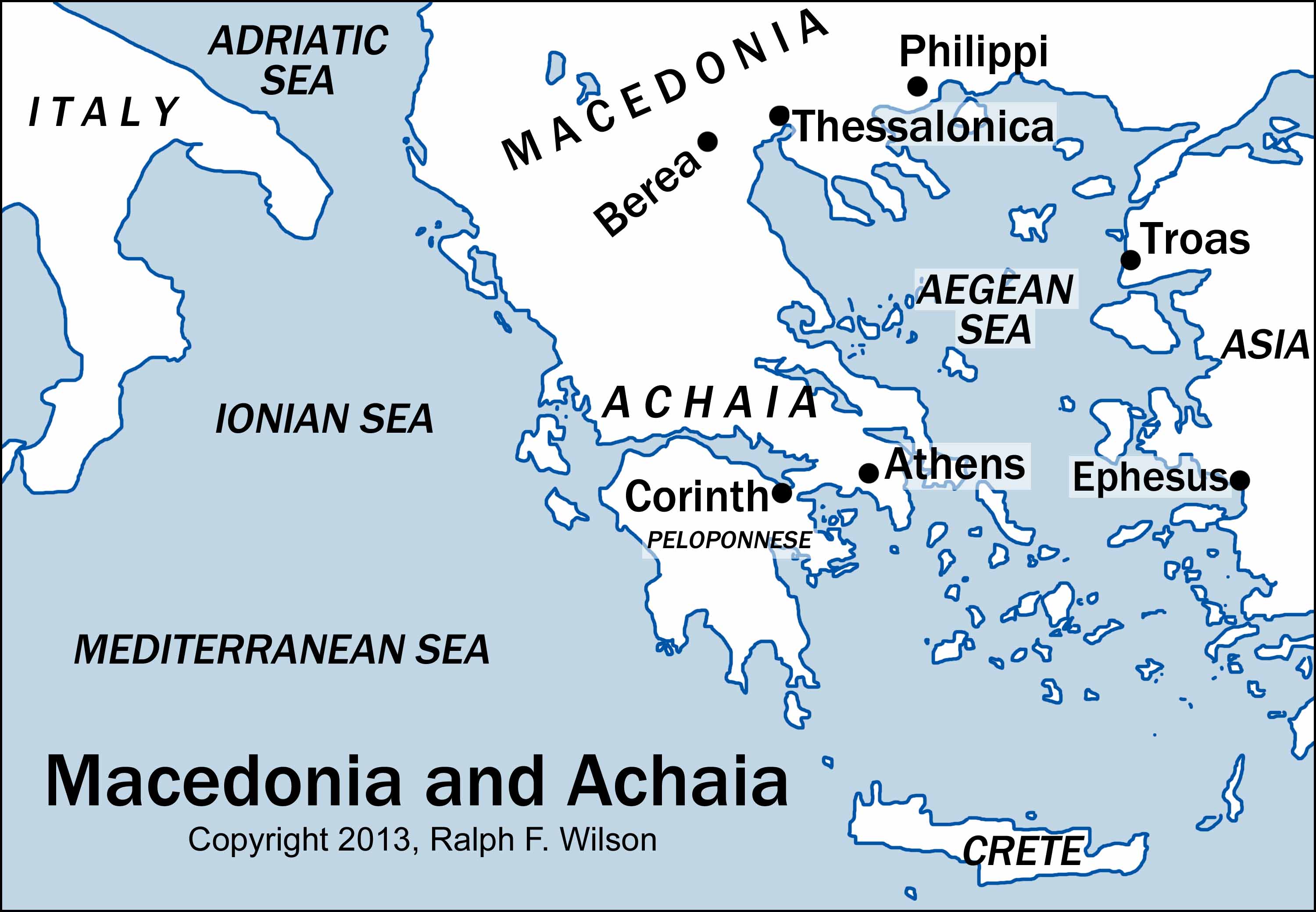
A.
City was most likely founded by Cassander, the brother-in-law of
Alexander the Great, and named for Thessalonike of Macedon,
Cassander's wife and Alexander's half sister.
B.
The city was so commercially important that during the Roman era it
was, for a short time, the capitol of all the Greek providences.
- Once the Roman Empire split in two – east and west, Thessaloniki, as it became known, was second in importance only to Constantinople, the Eastern capitol of Rome
- Around 1519, the city became 54% Jewish as many persecuted Jews from Spain fled there. The city was made up of Jews, Greek Orthodox and Muslims, with a Jewish plurality. For the next 200 years, Thessaloniki had the largest Jewish population of any other city in the world. Apparently New York City and Miami Beach did not yet exist.
E.
Sadly, Thessaloniki fell to Nazi Germany in 1941 and all but 1000
Jews were exterminated
F.
Today, Thessaloniki is a thriving port city in Greece and home to
the largest Greek university The Aristotle Universtiy of
Thessaloniki.
Chapter
1 – Though Paul started his ministry in Thessalonica in the Jewish
synagogues, a large portion of the church was made up of Gentiles who
were formerly idol worshipers, as indicated by verse 9. Paul uses
his introductory paragraph to establish his authority in spiritual
matters, the inclusion of former idol worshiping Gentiles into faith
and how healthy spiritual growth has resulted in growing the church
and missions.
- V. 1-2 – Paul, Silas and Timothy established this church, and are now following up as concerned spiritual parents. These missionary disciple makers are in constant prayer for the converts.
Prayer
is a key component. We are to be praying for one another, concerned
for each other's well being. When we pray for one another, we grow
closer to each other in fellowship. Petty disagreements or
differences will evaporate as we begin to see each other as Christ
does.
Prayer
for each other as a group and as individuals will bring cohesion like
no other thing. The best way to overcome personality conflicts is to
pray for the person you are conflicted with. Being too busy is no
excuse. Paul was busy establishing churches all over the Near East
and still found time to pray for those he was ministering with and
to. If you find that you do not have time to pray for the people in
your life, you are probably wasting time in worthless pursuits. If
you spend more time per week watching TV than you do in spiritual
pursuits, you are missing out on a tremendous opportunity to grow.
Pray
for one another, pray for each other, pray for those God has placed
in your life, whether you like them or not. You will be blessed!
WEEK 2
WEEK 2
Chapter
1:3-10 – Last time we looked at prayer and the fact that Paul and
his partners in the Gospel continued to pray for this fledgling
church and the people in it and how important is is for us to
continue to pray for one another. Now we will look a little more at
Paul's prayers and his encouragement to the Gentile believers.
- V. 2-3 – the prayers are specific. Paul took the time to know what these people were dealing with and then he prayed about those things. As the church, we have to have enough care for one another to be able to pray specifically. That is why we need to have, in addition to corporate worship we do on Sunday, small groups like this and the care groups. Lone Ranger Christianity is a flawed model and we cannot function properly without community and accountability.
- V.4-5 – This speaks to the fact that the validity of the faith of the Gentile believers was being called into question by the Jews in the synagogue. This was a church that was persecuted from the very beginning. Paul and his companions were attacked and driven out of the city and Jason, their host was accused of sedition.
The
Jews had the sacred writings of scripture and were far more familiar
with them than the new Gentile converts who had no previous contact
with God's word. It would be relatively easy for the non-believing
Jews to convince the new believers that they were not chosen by God.
The first New Testament writing these people were ever introduced to
was this letter.
Paul
reminds them of the miracles they saw and the evidence of the Holy
Spirit indwelling them after conversion. The Gentile believers had
the evidence of supernatural confirmation of their born again status.
Along
with that, they also had the character of Paul, Silas and Timothy as
further evidence of the truth. Character counts! Our behavior is far
greater testimony of our faith than our words. Jesus pointed out the
hypocrisy of the “religious” Jews: Matthew
15:8 - “‘This
people honors me with their lips, but their heart is far from me;
The character of those persecuting the believers must have contrasted greatly from the example shown by Paul and company.
The character of those persecuting the believers must have contrasted greatly from the example shown by Paul and company.
As
believers, it is imperative that we live out our faith. Unbelievers
need to see something different and new believers need the example.
Theologian Brennan Manning said, “The greatest single cause of
atheism in the world today
is Christians who acknowledge Jesus with their lips and walk out the
door and deny Him by their lifestyle. That is what an unbelieving
world simply finds
unbelievable."
- V. 6 – The example Paul and his companions gave was something to be emulated.What kind of example are we? Are we to be emulated?These new believers did follow the good example given to them by Paul and it had great results
- V. 7-8 – the fruit of their faith and obedience is reproduction. Larry Taylor wrote in Things I Learned From My Pastor: “Healthy sheep beget sheep.” What this means is that when we live according to the Word and live out our faith in devotion and obedience to God, evangelism is the natural by product. These new believers were living out their faith properly and the result was evangelism well beyond their own borders.As we live in faith and obedience, we affect others around us and we gain the opportunity to share our faith and we gain the opportunity to model a better way for those who are struggling.
- V. 9-10 – This passage reveals that the church is largely made up of Gentile believers and these non-Jewish believers are the main audience of this letter. Jews would not have turned away from idols because they would not have been involved with idol worship. The book of Ezekiel details Israel's sin of idolatry leading to national destruction. Ezekiel 20:31"When you offer your gifts, when you cause your sons to pass through the fire, you are defiling yourselves with all your idols to this day. And shall I be inquired of by you, O house of Israel? As I live," declares the Lord GOD, "I will not be inquired of by you.Ezekiel 23:30'These things will be done to you because you have played the harlot with the nations, because you have defiled yourself with their idols.We find in the book of Nehemiah Israel understanding that idol worship led to their destruction and as the nation was restored, the people were taught the damage idolatry led to and the people promised to flee from idolatry. The nation never had a problem with idolatry again. Therefore, it is safe to conclude that Jewish converts to Christianity were not included in this passage.
Paul
also takes the time to remind these persecuted Christians that Jesus
will return for them and they will not endure the wrath that is
coming on the world and on those who persecute God's people.
The
bottom line for us, is we need to be mindful of out lifestyle and
public witness. Our words are meaningless if our lives do not match
our professed faith.
WEEK 3
JUNE 8
WEEK 3
JUNE 8
CHAPTER
2 – Last week, we looked at the fact that the Gospel came to the
Gentiles in Thessalonica and that the church there was primarily
Gentile as the Jews in the synagogue mostly and violently rejected
the truth. We also spoke about the necessity of living our lives
compatibly with our professed faith. Now we will look at Paul
expressing encouragement to the young church reminding them of the
manner in which he and his companions shared the Gospel with pure
motive. We find in these passages the blueprints for being a servant
of the Lord.
- V. 1 –The servant of the Lord does not serve in vain. Even if we do not get the results we expect or desire, the success is in obedience.Even just proclaiming the word is never in vain. Isaiah 55:11 So shall my word be that goeth forth out of my mouth: it shall not return unto me void, but it shall accomplish that which I please, and it shall prosper in the thing whereto I sent it.
- V. 2 – The servant of God cannot allow adversity to interfere with service. In Acts 16, we find the account of Paul's exploits in Philippi. Three major events marked Paul's time in Philippi: First- the conversion of Lydia- Act 16:13 And on the Sabbath day we went outside the gate to the riverside, where we supposed there was a place of prayer, and we sat down and spoke to the women who had come together. One who heard us was a woman named Lydia, from the city of Thyatira, a seller of purple goods, who was a worshiper of God. The Lord opened her heart to pay attention to what was said by Paul. And after she was baptized, and her household as well, she urged us, saying, "If you have judged me to be faithful to the Lord, come to my house and stay." And she prevailed upon us.
Next
Paul casts an evil spirit out of a girl who happens to be a slave
used to earn money through divination. Because of the loss of
income, the slave girl's owners brought Paul and Silas before the
city officials and had them beaten and imprisoned -
Act
16:22
The crowd joined in attacking them, and the magistrates tore the
garments off them and gave orders to beat them with rods. And when
they had inflicted many blows upon them, they threw them into prison,
ordering the jailer to keep them safely. Having received this order,
he put them into the inner prison and fastened their feet in the
stocks.
Next,
one of the most well known conversions in the Bible, the Philippian
jailer. After having been beaten and jailed, Paul and Silas, rather
than sit and sulk, questioning God's love, they began to sing praises
unto God. Miraculously, the jail is opened and their chains are
broken. The jailer, about to kill himself due to the loss of
prisoners, is led to the Lord and ultimately, so is his family - Act
16:30 Then he brought them out and said, "Sirs, what must I do
to be saved?"
And they said, "Believe in the Lord Jesus, and you will be
saved, you and your household." And they spoke the word of the
Lord to him and to all who were in his house. And he took them the
same hour of the night and washed their wounds; and he was baptized
at once, he and all his family. Then he brought them up into his
house and set food before them. And he rejoiced along with his entire
household that he had believed in God
The
bottom line here is that no matter how adverse circumstances may be,
if you are in God's will and continue to trust and give Him the
glory, God's purpose will be accomplished through you.
- V. 3-8 – The servant of the Lord does not seek his own good but the good of others. Paul and his companions had one goal in mind, the salvation of lost souls. These men were not interested in any benefits of notoriety or prestige. They made themselves of no account, following the model of Christ Himself, who came as a suffering servant to save mankind. Philippians 2:5-7 Have this mind among yourselves, which is yours in Christ Jesus, who, though he was in the form of God, did not count equality with God a thing to be grasped, but emptied himself, by taking the form of a servant, being born in the likeness of men. And being found in human form, he humbled himself by becoming obedient to the point of death, even death on a cross.
To
be an effective minister of Christ, we have to forget about our own
comfort, our own desires and put ourselves in a position where we are
willing to suffer if needed. This does not mean we purposely bring
harm to ourselves in order to feel holy or seem spiritual, but
willing to be led wherever God leads and do without what we consider
our rights.
- V. 9-10 – The servant of the Lord carries his own load. When we serve God, the last thing we should be concerned about is financial gain. If our concern is financial gain, our hearts will not be right and we will be ineffective in service. Jesus told us this in Matthew 6:24 "No one can serve two masters. Either you will hate the one and love the other, or you will be devoted to the one and despise the other. You cannot serve both God and money. If finances are our concern, we will not be able to go all out for Christ because we will be thinking about the bottom line. If God has clearly directed us in a certain way, we have to trust that He will provide what we need to accomplish His goal. Paul was a tentmaker, as we see in Acts Acts 18:1-3 After this Paul left Athens and went to Corinth. And he found a Jew named Aquila, a native of Pontus, recently come from Italy with his wife Priscilla, because Claudius had commanded all the Jews to leave Rome. And he went to see them, and because he was of the same trade he stayed with them and worked, for they were tentmakers by trade. We get the impression that Paul was working as an evangelist by day and a tentmaker by night, or possibly vice versa. Either way, Paul used the ability God gave him to earn his keep and still remained diligent in serving in his spiritual gift and calling. Sometimes, god calls us to trust in His provision from the support of other believers: Luke 10:3-7 Go your way; behold, I am sending you out as lambs in the midst of wolves. Carry no moneybag, no knapsack, no sandals, and greet no one on the road. Whatever house you enter, first say, 'Peace be to this house!' And if a son of peace is there, your peace will rest upon him. But if not, it will return to you. And remain in the same house, eating and drinking what they provide, for the laborer deserves his wages. Do not go from house to house.Sometimes we are expected to earn our keep and still do ministry, as Paul demonstrated in his travels. This is all part of the personal nature of our relationship with Christ. We must abide in Him in order to discern His plan for our provision in any given circumstance.
Chapter
2:11
Last time we looked
at some key aspects of being a servant of the Lord:
- The servant of the Lord does not serve in vain
- The servant of the Lord does not allow adversity to interfere with service
- The servant of the Lord does not seek his own good
- The servant of the Lord carries his own load
Continuing
on this theme, we will look at a couple of more aspects and
characteristics of being a servant of the Lord
- V11-12 – The servant of the Lord sees potential in others and tries to draw it out of themPart of Paul's ministry to the Thessalonians was to encourage them to holiness. Paul not only encourages them but charges them to live lives worthy of God
this should lead
to deep contemplation – What does it mean for us to live lives
worthy of God?
How
do we, without self righteousness or pride, bring this message to
others?
- V. 13 – The servant of the Lord is grateful for the fruit of his labor.
Paul is giving
thanks to God for the harvest of souls. We should expend great
effort in seeking God's blessing on our service, but we also must
give thanks when our efforts bear visible fruit.
As
we look at Paul's gratitude, we see three important elements at work
in his ministry
- the will of the messenger
- the will of God
- the will of the believer to believe – 1 John 2:2, 2 Peter 3:9
Paul
is grateful to God that the message he presented was received as he
meant it to be received.
- The Thessalonians accept the word as God's not man's and Paul recognizes that God was at work in the believers. We see a beautiful view of God's power and sovereignty coupled with human responsibility, working together for salvation
- WEEK 4
- JULY 26
- V. 14 – The servant of the Lord follows godly examplesThis is discipleship. Learning from those who have gone before us and teaching those who come afterMatthew 28:19 Go therefore and make disciples of all nations, baptizing them in the name of the Father and of the Son and of the Holy Spirit,
- V. 14-16 – The servant of the Lord stands firm against persecution
- Ephesians 6:13 - Therefore put on the full armor of God, so that when the day of evil comes, you may be able to stand your ground, and after you have done everything, to stand.
- Revelation 2:25-27 Only hold fast what you have until I come.The one who conquers and who keeps my works until the end, to him I will give authority over the nations, and he will rule them with a rod of iron, as when earthen pots are broken in pieces, even as I myself have received authority from my Father.
- We see throughout scripture that we are called to stand firm and that we are give the ability to stand firm.
- Matthew 10:19 - When they deliver you over, do not be anxious how you are to speak or what you are to say, for what you are to say will be given to you in that hour.
Our faith should be
self replicating as we learn from the believers past, we pass our
faith on to others
- V. 17-18 – Paul was hindered by Satan, so we cannot be discouraged when we pray for something or yearn to do something and find we cannot. Even though Satan may be hindering us, God is ultimately in charge and Satan is thwarted in his intentions.Genesis 50:20 As for you, you meant evil against me, but God meant it for good, to bring it about that many people should be kept alive, as they are today.
- Even Satan's attacks can and will be used against him for God's purposes
Ultimately,
Romans 8:28 comes into play – All things work together for good to
them that love the Lord and to those who are called according to His
purpose.
Sometimes as our plans or expectations fail, we may experience anger toward God. This is not something we want to allow to grow and cause bitterness and rebellion. We must face this head on and be honest with our loving Father, in order to heal from our hurt and in order to see things from a more heavenly perspective. For more on this, CLICK HERE
- V. 19-20 – Paul sees the fruit of his labor as his glory and for boasting. When we bear fruit in ministry, whatever we are called to do, that is investing in our eternal bank for future glory. We think of the parable of the talents, the man who earned 10 was given not only charge over 10 cities, but the talent of the man who earned no extra talents. We should not serve for the reward but rest assured, anything you lose in this life for the cause of Christ will be more than compensated for in eternity.
- Matthew 19:28-29 And Jesus said unto them, Verily I say unto you, That ye which have followed me, in the regeneration when the Son of man shall sit in the throne of his glory, ye also shall sit upon twelve thrones, judging the twelve tribes of Israel. And every one that hath forsaken houses, or brethren, or sisters, or father, or mother, or wife, or children, or lands, for my name's sake, shall receive an hundredfold, and shall inherit everlasting life
WEEK 5
AUGUST 3
1
Thessalonians 3
- V. 1-2 – Church growth does not happen without some being called out. A group that works well together and enjoys good fellowship can become very comfortable and stagnant, striving for status quo. Paul had use of Timothy in Athens. Paul was in a hostile environment and enjoyed the comfort of a fellow worker. Paul also recognized that in order for the Gospel to be strengthened in Thessalonica, he would have to sacrifice his comfort for the sake of ministry.
We
see this having taken place in Jerusalem at the death of Steven, Act
8:4
Therefore they that were scattered abroad went every where preaching
the word. As
the church experienced persecution, the believers were driven from
their homes and into other countries where they could worship in
safety. I am sure it was not with joy that these believers were
driven into strange lands but, as God dispersed them into other
lands, the the Gospel spread. Peter's epistles were directed to
these displaced believers specifically.
We
may find ourselves driven out of our comfort zones for God's greater
purpose, or we may have to say goodbye to those whom we love and find
companionship with for the spread of the Gospel. In our comfort and
complacency, we can grow weak in faith and begin to be distracted
from the mission.
- V. 3 – Paul sent Timothy to comfort and strengthen the church that was being persecuted and attacked. We can expect opposition when we endeavor to serve God. We are living in Satan's realm and this world system is set up to prosper those who serve Satan's agenda. We may see some who are abusing the Gospel for personal gain and wonder why they are allowed to prosper or even how their ministry can seem to be blessed by God, but is it really? Is it possible it is being blessed by Satan to pervert the truth of scripture and lead others astray according to their own lusts and desires?
WEEK 6
AUGUST 10
- V. 4-5 – Paul recognized the fact that believers who are actively pursuing faith will suffer. We will be ostracized, we will be outcast, we will be mocked or vilified or even shunned. The message of the Gospel is contrary to the mindset of the carnal man and is in opposition to the world system we live in. Those successful in entertainment often pay homage to dark spiritual forces in order to attain or maintain success. The love of money has derailed many a minister and ministry. Jim Bakker is a perfect example of this as he started out in sincerity and quickly fell from grace because of the allure of money and fame. As he sat in prison cleaning toilets, he realized just how far he had fallen and even wrote a book entitled I Was Wrong.
Paul
knew that many in the fledgling church were struggling with the
temptation to abandon their faith, if for no other reason but to
regain their public standing. Satan works at us, discovering our
weaknesses exploiting them to destroy our faith and testimony. This
is why personal accountability is so important, accountability to the
spiritual authority God has placed over us and accountability to one
another.
Luke
8:13-14 And the ones on the rock are those who, when they hear the
word, receive it with joy. But these have no root; they believe for a
while, and in time of testing fall away. And
as for what fell among the thorns, they are those who hear, but as
they go on their way they are choked by the cares and riches and
pleasures of life, and their fruit does not mature.
Paul
feared, that the new converts would fall victim to Satan's temptation
to fall away due to the cares and troubles they were experiencing.
We see from the example of these persecuted believers that it is
possible to stand firm and not fall away. It gets very tempting to
walk away from the Christian life, life seems to like it might be
easier if we give up and go back to our old life. We have to remember
that we are not living for this life, but for the life to come and
once we go all in for Christ, life is not about us anymore. It's
about Him and others.
- V.6-7 – When we are obedient to God, our fruit can be a source of comfort during bad times.If we are going through a rough spot in our spiritual life, recounting past victories, past fruit and answered prayer can become a source of inspiration. As we remember what God has done for us in the past, it is easier to go through struggles.
Psalm
23:4 - Yea, though I walk through the valley of the shadow of
death, I will fear no evil: for thou art with me; thy rod and thy
staff they comfort me. How is it that we can
know that God is with us, we recall the things He has done and we
hold fast to the promises He has given us in scripture.
- V. 8-11 – As we grow in our faith, our focus should beincreasingly outward, toward others. It is very dangerous for us to get caught up looking inwardly and after our own interests and desires. Part of our spiritual maturity is seeking after the welfare of others. Here Paul says he can live, knowing the believers in Thessalonica are standing firm in the faith.
Paul's
desire is to see others impacted by the Gospel, knowing that as new
believers mature, they will lead others to Christ and the Gospel will
continue to spread. Paul desires to see those he has led to Christ.
We too, ought to desire fellowship with other believers. This faith
is not about us, but completely God and others centered.
- V. 12-13 – Loving one another is a true measure of our commitment to God. We naturally love ourselves. No one has to tell us to look out for our own interests, we are all about taking care of ourselves. But notice the focus Paul emphasizes - looking to the coming of Christ. We obey and love now, with eternity in sight. This is why we study revelation and get excited when we talk of end times and prophecy, because we know that one day all we do here will have meaning and purpose n eternity.
Have
you ever asked yourself, “what's the difference?” or “why
bother, what's going to happen is what's going to happen?” Well,
there is a difference that we make, there is a difference we make in
the lives of others and there is a difference in what we are
investing in in eternity.
One
of my favorite quotes of Bill Yoder (one of our Bible Study members)
is something he may not even remember saying: “What is a soul
worth?” is it worth our discomfort or inconvenience to love
someone into the kingdom, is it worth sacrificing my leisure time or
pursuit of my hobbies to show someone that they matter to me and more
importantly, to God? Loving others with eternity in mind can and
should revolutionize your outlook on life.
WEEK 7
August 24
WEEK 10
SEPTEMBER 14
WEEK 7
August 24
THESSALONIANS
4
We
continue to look at the book of Thessalonians, a letter written to a
fledgling church established by the Apostle Paul before he was driven
out by persecution. As he traveled about, Paul's concern for the
church grew as he was aware of the great persecution the new
believers were experiencing. He also heard good reports from the
surrounding region, of how the faithfulness of the Thessalonians was
an inspiration to others. Paul sent Timothy, his protege, to check
on the church and bring back a report. This letter is a response to
the report Timothy brought back to Paul
- V. 1 – a call to continued spiritual growth. We cannot ever come to a place where we think we have arrived, spiritually speaking. A true disciple must continue to learn, grow and transform. This is what we call sanctification. The work of the Holy Spirit in the life of a believe is to transform us into the image of Christ. Christ was perfect, we will never be perfect, so we can never stop growing. Romans 8:29 For those whom he foreknew he also predestined to be conformed to the image of his Son, in order that he might be the firstborn among many brothers. There are no degrees of perfection, either. Almost perfect is like saying almost infinite or almost omnipotent. We cannot logically be almost something that has no limit.
Our
spiritual growth and sanctification is a lifetime pursuit, always
striving to learn more and to be better. So even though we can come
to a place where we may be commended for obedience or change, we
cannot be satisfied with a little change, or even a lot of change,
for that matter.
- V. 2-8 – Here is a serious call to sexual purity. The culture these new believers were coming from was one of very little sexual restraint. Sexual licentiousness was part of religious practice and just an accepted part of life.
Today,
we are living in a society that has always been less then chaste, but
is, especially in the last generation, become more and more sexually
sinful. Recently, I read an article about a young man who was
reunited with his birth mother and the two found themselves in a
sexual relationship. They are now petitioning the court to allow
them to be together without breaking incest laws. They call this GSA
– Genetic Sexual Attraction. So, as if the whole gender neutral
phenomenon is not enough, now we have parents and children fighting
for the right to be sexually active together.
I
remember watching an episode of an 80's sitcom with my kids a couple
of years ago and being refreshed at how co habitation by non married
couples was still pretty taboo. Today, it has become the norm.
Dating seems to equal sexual behavior and is almost expected by the
second date. I have a single friend in his 40's who lamented to me
that it is getting harder and harder to meet a girl who has not have
relations with another girl. There seems to be little or no
boundaries when it comes to sexual immorality.
DISCUSSION:
So, as the culture changes and promiscuity becomes the norm, as a
younger demographic comes to church, with that world view and
perspective, how do we as a church remain true to scripture and
remain culturally relevant?
DISCUSSION:
Do we pick and choose which sexual sin we attack? Do we condemn
homosexuality but ignore co-habitation of the unmarried? Do we
condemn adultery but turn a blind eye to an unmarried who “plays
the field”?
DISCUSSION:
How do we balance welcoming sinners unto salvation with dealing with
sexual sin in the congregation? At what point do we demand purity,
or how long do we allow sexual sin in the camp with new believers?
WEEK 8
AUGUST 31
WEEK 8
AUGUST 31
1
Thessalonians 4:9-18
Last
week, we took a deep look at sexual impurity in the church and
discussed the problem of being a sexually pure church in a sexually
“liberated” society. The world equates love with sex. We are
called to love but to abstain from sexual impurity. As we look at
tonight's passage, we will discuss Biblical love that we are to have
for one another.
- 9-12 – this passage is loaded with application
9
– the Thessalonians were taught by God to love one another – they
had the OT and the Holy Spirit, we have the whole counsel of God,
both OT and NT and the Holy Spirit indwelling, how much more are we
responsible to love one another?
1John
4:20 If anyone says, "I love God," and hates his brother,
he is a liar; for he who does not love his brother whom he has seen
cannot love God whom he has not seen.
And this commandment we have from him: whoever loves God must also
love his brother.
WHAT
KIND OF THINGS HINDER US FROM LOVING OTHERS? THINK, QUIETLY TO
YOURSELF, WHAT THINGS IN YOUR LIFE ARE KEEPING YOU FORM LOVING OTHERS
AS YOU ARE SUPPOSED TO? THE POINT OF US STUDYING THE WORD IS WE ARE
USING SCRIPTURE AS A MIRROR IN WHICH WE SEE A TRUE IMAGE OF
OURSELVES. IF WE ARE NOT CHALLENGED OR CONVICTED AT SOME POINT, THEN
OUR STUDY IS POINTLESS. WE SHOULD NOT BE STUDYING TOGETHER FOR THE
SOLE PURPOSE OF REINFORCING OUR POSITION, BUT FOR CONTINUED
SANCTIFICATION
One
of the most destructive things in a believer's life is pride. Pride
leads to jealousy, animosity and disdain for others. Loving others
is so basic and foundational, we sometimes pass over passages like
this without any real self examination.
10
– Even here, Paul is commending them for loving but at the same
time exhorting them to do so more and more. As we saw last week,
there are no degrees of perfection, our spiritual growth is limited
only by the number of years we are given.
11-12
– This little passage seems like it should be common sense, yet may
be one of the hardest things in the world for some people. Jesus
addressed this speaking of motes and beams: Matthew
7:3-5 Why do you see the speck that is in your brother's eye, but do
not notice the log that is in your own eye? Or how can you say to
your brother, 'Let me take the speck out of your eye,' when there is
the log in your own eye? You hypocrite, first take the log out of
your own eye, and then you will see clearly to take the speck out of
your brother's eye.
I
was listening to a guy on the radio today, Matt Maher, who, while in
prison began a ministry. He was put in a cell with a guy that hated
Christians. The man that hated Christians was a former enforcer for
the mob in New York. The enforcer eventually came to Christ because
he watched and waited for Maher to slip up, to curse, or fight or do
something dishonest, proving to be a hypocrite like “every other”
Christian he had come in contact with. Maher lived as he professed
and made an incredible impact on the mob enforcer.
Even
those who are opposed to us or our message can be impacted by our
lives lived out in quiet submission to Christ. When we whine and
complain about everything, when we ask others to do for us what we
are capable of doing for ourselves we repel people from ourselves and
ultimately our message.
WEEK 9
SEPTEMBER 7
SEPTEMBER 7
- 13-18 – Here, Paul shifts major gears as he moves from exhortation to holy living to encouragement of why we are living in holiness. Paul describes the event that we should all be longing for, the resurrection and rapture of the church. This is great hope for those of us who have lost believing loved ones, this is great hope for us who are awaiting the return of our Lord.
There
is no debate that this passage refers to a resurrection and rapture,
the debate is as to when this takes place on the prophetic timeline.
We can have this debate, and we can disagree on timing, what we
cannot disagree on is that there is a resurrection.
1Corinthians
15:12-20 Now if Christ is proclaimed as raised from the dead, how
can some of you say that there is no resurrection of the dead? But
if there is no resurrection of the dead, then not even Christ has
been raised. And if Christ has not been raised, then our preaching
is in vain and your faith is in vain. We are even found to be
misrepresenting God, because we testified about God that he raised
Christ, whom he did not raise if it is true that the dead are not
raised. For if the dead are not raised, not even Christ has been
raised. And if Christ has not been raised, your faith is futile and
you are still in your sins.
Then
those also who have fallen asleep in Christ have perished. If in
Christ we have hope in this life only, we are of all people most to
be pitied. But in fact Christ has
been raised from the dead, the firstfruits of those who have fallen
asleep.
Foundational
to our faith is the resurrection of Christ, the resurrection of the
dead and the gathering of the Church to Christ. Paul, himself, told
us that without that hope, we have nothing. When things get tough,
we can find comfort in the knowledge that one day we will be united
together with our Lord and all things will be made new.
Chapter
5
- V. 1-2 – This passage leads us to the million dollar question: WHEN WILL CHRIST RETURN?
Countless
books and documentaries have been produced claiming to know the time
of Christ's return. The exact time is not for us to know, but we are
to be prepared.
If
you knew your house was going to be broken into on September 23, you
would make sure you were home, maybe armed, or having the police
there waiting on that night. If you knew you were going to be broken
into on some night, you
would make preparations, maybe you would get a good guard dog or a
security system. Assuredly, you would be diligent each night each
night to check your locks and other security measures. That is how
God wants us to be awaiting His return, diligent, ready and waiting –
prepared.
10
VIRGINS
Mat
25:1-13
"Then
the kingdom of heaven will be like ten virgins who took their lamps
and went to meet the bridegroom.
Five
of them were foolish, and five were wise.
For
when the foolish took their lamps, they took no oil with them,
but
the wise took flasks of oil with their lamps
As
the bridegroom was delayed, they all became drowsy and slept.
But
at midnight there was a cry, 'Here is the bridegroom! Come out to
meet him.'
Then
all those virgins rose and trimmed their lamps.
And
the foolish said to the wise, 'Give us some of your oil, for our
lamps are going out.'
But
the wise answered, saying, 'Since there will not be enough for us and
for you, go rather to the dealers and buy for yourselves.'And while
they were going to buy, the bridegroom came, and those who were ready
went in with him to the marriage feast, and the door was shut.
Afterward
the other virgins came also, saying, 'Lord, lord, open to us.'
But
he answered, 'Truly, I say to you, I do not know you.'
Watch
therefore, for you know neither the day nor the hour.
Jesus
seems to be indicating that only ½ of those who call themselves the
church have the Spirit of God and the other ½ are not true
believers. Before you start looking around the room trying to figure
out which half of us are going to hell, that this is speaking of half
the Church in all the world, at His coming. Some congregations are
filled with unbelievers, like for instance a universalist church or
kingdom hall. Other churches, like Berean, are Gospel intensive and
would have a high percentage of true believers. Likewise, some
nations will have a higher percentage of believers than others. It is
estimated that no more than 5% of China is Christian, which is about
68 million, according to Pew Research. 37% of American Christians
identify themselves as born again. That is about about 101 million
Americans, just over ¼ of the population. Think about that number,
almost 75% of America is going to hell.
The
reason Jesus gave us this parable is so that we are diligent in our
faith. There are people in our lives who think they are Christians
and yet have no clue about what God requires for salvation. Simply
sharing the facts of the Gospel in our culture is not enough. We have
to be intentionally discipling people. We have to invest our lives in
the lives of others. Some will see the requirements of true
salvation and turn away and some will come to Christ in a real way.
Jesus had 5000 turn away from Him in one day. They were not
willingly to truly trust in Christ.
Easy
believeism, benefits oriented Gospel, works based theology, and the
health wealth and prosperity Gospel are just some examples of things
that cause people to call themselves Christians with out truly being
born again. True salvation should be life changing and fruit
bearing.
The
bottom line is that we are to be ready for an imminent return of
Christ and not trying to figure out dates and times. It is ok to
look at prophecy and to get excited as we see things taking place,
but we cannot get caught up on date setting because so far, every
date setter has been 100% wrong.
WEEK 10
SEPTEMBER 14
1
Thessalonians 5:3-8
Last
week we looked at the second coming of Christ as it relates to
believers. This week we will look at how Christ's return will affect
unbelievers.
I.
V. 3 – this passage is speaking of unbelievers, those who do not
care about God or Jesus. These will be taken by surprise at His
coming. This passage is one that leads me to the belief in a
pre-tribulation rapture. The description in Revelation of the
Tribulation is anything but peace and security. Regardless – the
world we live in continues to slide further and further into
immorality and government control and oversight. I can imagine the
godless would view these things very favorably, flaunting their
liberation from God's laws and standards. Recently, the Burning Man
Festival was held in the Nevada desert. Burning Man is a microcosmic
view of what a world given over to the flesh would look like.
Illicit drug use, spirituality without accountability, sexual
freedom, and no real responsibility. This is the Utopian goal where
the government takes care of basic needs and life is one big party.
Lennon and McCartney outlined the Utopian dream in the song Imagine:
Imagine
there's no heaven
It's easy if you try
No hell below us
Above us only sky
Imagine all the people
Living for today... Aha-ah...
It's easy if you try
No hell below us
Above us only sky
Imagine all the people
Living for today... Aha-ah...
Imagine
there's no countries
It isn't hard to do
Nothing to kill or die for
And no religion, too
Imagine all the people
Living life in peace... You...
It isn't hard to do
Nothing to kill or die for
And no religion, too
Imagine all the people
Living life in peace... You...
You
may say I'm a dreamer
But I'm not the only one
I hope someday you'll join us
And the world will be as one
But I'm not the only one
I hope someday you'll join us
And the world will be as one
Imagine
no possessions
I wonder if you can
No need for greed or hunger
I wonder if you can
No need for greed or hunger
A
brotherhood of man
Imagine all the people
Sharing all the world... You...
Imagine all the people
Sharing all the world... You...
You
may say I'm a dreamer
But I'm not the only one
I hope someday you'll join us
And the world will live as one
But I'm not the only one
I hope someday you'll join us
And the world will live as one
Notice
how the first thing eliminated is consequences, no heaven, no hell,
so guess what, if there is no heaven or hell, there is no God, or at
least not the God of the Bible. The discarding of religion is viewed
as necessary for mankind to live in peace.
As
society creeps towards this ideal, a false sense of safety and
security will prevail and then, suddenly, because of continued
ignored warnings, all hell will break loose on earth.
I
love the analogy of sudden labor pains. Think of a pregnant woman
who will not admit, even to herself, that she is pregnant. The
obvious signs are present, others point out the need to prepare for
birth, yet she refuses to listen to reason. Then, one day, labor
hits, and it is too late to prepare, here comes a baby!
We
can warn people, we can point to signs of the end, we can do all we
can, yet most people will continue in unbelief. These who continue
in unbelief will be very surprised when Christ returns and they are
not prepared.
- v. 4-8 – though we cannot know the day or hour, we should be anticipating Christ's return as immanent. We prepare by being diligent in our relationship with God, by sharing our faith with those God places in our path and by living in the light. WHAT DOES LIVING IN THE LIGHT MEAN TO YOU?
Think
of when most crime and mischief takes place, at night.
Living
in the light means we are without duplicity, we are open, available
to others, alert to the needs of others, alert to dangers of
temptation.
WEEK 11
WEEK 11
SEPTEMBER 21
1 Thessalonians 5:9-13
I. V. 9-11 – what we know is that as believers, we are not destined for wrath, but destined for salvation and eternal life with God. This should affect our lives in as much as we are living for eternity, not the moment. If we have eternity in sight, we can endure life here better. If we live for the here and now, we will never be satisfied. We will always be looking for the next cool thing, “whatever that may be for you as an individual. Living for the here and now, we worry about getting a fair shake, we worry about our “rights” and what we think we are owed. With eternity in sight, material possessions, hurt feelings over petty slights, watching the wicked prosper and the honest suffer suddenly does not seem so important. As we saw, last week, in the lyrics to Imagine the Utopian ideal is to be able to live without eternal consequences, we understand eternal consequences and rewards.
As we live for eternal reward, we must keep in mind that, as we looked at 2 weeks ago, about 75% of America is going to hell. That is motivation for out eternal perspective.
Notice verse 10 says “whether awake or asleep, we shall live with Him.” This brings us right back to verse 13, speaking of th day of the Lord – all in Christ shall be with Christ on the day of the Lord. Wherever you place that day on the end times time line. This is what we are to encourage one another with – our hope in the resurrection.
II. V. 12-13 – This is always a difficult passage to expound upon with humility, so I will allow it to speak for itself and take any questions.
The second part of 13 is important for us to keep on mind. We are to be at peace among ourselves. That means overlooking minor affronts, and treating others with respect. We remain at peace with one another when we are open and honest, not holding grudges or bad mouthing someone. If you have a problem with someone, go to them and say so. I would much rather you come to me with a problem you have with me rather than harbor a grudge or ill feelings. Generally, when we hurt one another it is not because we set out to hurt others, we are doing or saying something that benefits ourselves and not thinking about the ramifications or consequences. If you have hurt people inadvertently, then chances are, the person who hurt you did so ignorantly as well. This is when we need to have grace. As we have been talking about walking in the light, part of that is being real with someone when they hurt your feelings.
WEEK 12
SEPTEMBER 28
III.V. 14 – There are those among us, in the church, who are inactive. Are they inactive because they are lazy or idle, are they afraid, are they weak in their faith? HOW CAN WE TELL? We tell by spending time with them. We actually have to step out of our comfort zone and spend time with people. Then, we have to carefully and prayerfully determine why someone is inactive. We have specific instructions on how to motivate them
The idle, or as I like to call them, the lazy are to be admonished. This is more than encouragement because this is people who know better and ought to be serving in some capacity. This is someone who has been a believer for awhile, knows the Word and probably once actively served.
The faint hearted: these lack confidence or possibly are afraid to step out. We handle this group more gently as they need to be encouraged and built up.
The weak: for this group, we must go beyond words and put our faith into action. We do what we can to help them.
This is discipleship. This is what we are all called to do. This is not a command for pastors or church leaders, this is a general epistle written to the church, not the church leadership.
Challenge: find someone who is inactive that you have a relationship with and find out why they are inactive and employ one of these three methods to get them moving.
WEEK 13
OCTOBER 5
1 Thessalonians 5:9-13
I. V. 9-11 – what we know is that as believers, we are not destined for wrath, but destined for salvation and eternal life with God. This should affect our lives in as much as we are living for eternity, not the moment. If we have eternity in sight, we can endure life here better. If we live for the here and now, we will never be satisfied. We will always be looking for the next cool thing, “whatever that may be for you as an individual. Living for the here and now, we worry about getting a fair shake, we worry about our “rights” and what we think we are owed. With eternity in sight, material possessions, hurt feelings over petty slights, watching the wicked prosper and the honest suffer suddenly does not seem so important. As we saw, last week, in the lyrics to Imagine the Utopian ideal is to be able to live without eternal consequences, we understand eternal consequences and rewards.
As we live for eternal reward, we must keep in mind that, as we looked at 2 weeks ago, about 75% of America is going to hell. That is motivation for out eternal perspective.
Notice verse 10 says “whether awake or asleep, we shall live with Him.” This brings us right back to verse 13, speaking of th day of the Lord – all in Christ shall be with Christ on the day of the Lord. Wherever you place that day on the end times time line. This is what we are to encourage one another with – our hope in the resurrection.
II. V. 12-13 – This is always a difficult passage to expound upon with humility, so I will allow it to speak for itself and take any questions.
The second part of 13 is important for us to keep on mind. We are to be at peace among ourselves. That means overlooking minor affronts, and treating others with respect. We remain at peace with one another when we are open and honest, not holding grudges or bad mouthing someone. If you have a problem with someone, go to them and say so. I would much rather you come to me with a problem you have with me rather than harbor a grudge or ill feelings. Generally, when we hurt one another it is not because we set out to hurt others, we are doing or saying something that benefits ourselves and not thinking about the ramifications or consequences. If you have hurt people inadvertently, then chances are, the person who hurt you did so ignorantly as well. This is when we need to have grace. As we have been talking about walking in the light, part of that is being real with someone when they hurt your feelings.
WEEK 12
SEPTEMBER 28
III.V. 14 – There are those among us, in the church, who are inactive. Are they inactive because they are lazy or idle, are they afraid, are they weak in their faith? HOW CAN WE TELL? We tell by spending time with them. We actually have to step out of our comfort zone and spend time with people. Then, we have to carefully and prayerfully determine why someone is inactive. We have specific instructions on how to motivate them
The idle, or as I like to call them, the lazy are to be admonished. This is more than encouragement because this is people who know better and ought to be serving in some capacity. This is someone who has been a believer for awhile, knows the Word and probably once actively served.
The faint hearted: these lack confidence or possibly are afraid to step out. We handle this group more gently as they need to be encouraged and built up.
The weak: for this group, we must go beyond words and put our faith into action. We do what we can to help them.
This is discipleship. This is what we are all called to do. This is not a command for pastors or church leaders, this is a general epistle written to the church, not the church leadership.
Challenge: find someone who is inactive that you have a relationship with and find out why they are inactive and employ one of these three methods to get them moving.
II.
V. This is far easier said than done. Our natural inclination is to
retaliate, defend, or hit back harder. Romans_12:19
Beloved, never avenge yourselves, but leave it to the wrath of God,
for it is written, "Vengeance is mine, I will repay, says the
Lord."
What
do we want to accomplish with with comeuppance? Do we want our
offender to receive retribution that is punitive or restorative? We
should want that person's restoration, with us if possible, but
certainly with God. God knows a person's weak spot and how to deal
with them in such a way as to afford them the greatest opportunity to
repent and change. So, we are called to do good to, not just one
another but EVERYONE. This means we do good to those in and out of
the church
- V.16 – The importance of worship: David was a shepherd boy with plenty of time and solitude on his hands. He did not sit around thinking about getting rich or having power or what kind of mischief he could get into, he used his solitude to worship God. The 23rd Psalm is a prime example. We get bored too easily and want constant entertainment. We have radios in our cars and games on our phones so we never have a quiet moment. Use the quiet times of solitude to spend time in worship.Rejoicing, thanksgiving, praise and worship are all necessary components of our spiritual lives. Doing this helps us keep things in proper perspective. We focus on God's love, faithfulness, provision, His magnitude, and our own inability and power in comparison. Rejoicing helps us stay humble and productive.
WEEK 13
OCTOBER 5
- V. 19 – To quench the Spirit is to ignore or hinder the prompting of God in your life and the life of others. When God is doing a work or we see a great victory over something in our lives, we run the risk thinking we have arrived somewhere and can take a break from holiness. Have you ever been focused on doing something that you knew you needed God's help with that you denied yourself indulgences or you abstained from certain things that you deemed sinful, only to accomplish your goal and go back business as usual? That is quenching the work of the Spirit. Rather than build on your spiritual success or accomplishment, we might feel a sense of relief and let down our guard or indulge in some sin as a reward to ourselves for a job well done. This is immature and dangerous behavior. Isaiah 28:9-10 "To whom will he teach knowledge, and to whom will he explain the message? Those who are weaned from the milk, those taken from the breast? For it is precept upon precept, precept upon precept, line upon line, line upon line, here a little, there a little." It is as we grow and graduate from spiritual meat that we build upon the things that God shows us and teaches us. We cannot “take a break” from holiness or a vacation from devotion, this will quench the work of the Spirit and we will regress and fail to ever grow past a certain level of maturity.
I.
V.17 – Prayer: I just got done reading the biography of the
evangelist Charles Finney. What an amazing story of a man who
committed himself to prayer and saw God perform amazing. wonders of
salvation. Finney's prayers were answered with amazing outpourings
of the Holy Spirit which led to huge revivals and moves of God in
numerous communities. If you are wondering why God is not moving in
your life or why you are not getting opportunities to serve, you may
very well be neglecting prayer. Even Jesus, on numerous occasions,
went off to pray in solitude.
Luke 5:16 - But he would withdraw to desolate places and pray.
Prayer
is how we plug into the power of God.
II.
V. 18 – this verse goes along with verse 1
IV.
V. 20-21 – We have to be careful not to believe every nonsense we
hear from those who purport to speak for God, but, we must also be
careful not to discount everything that is spoken as prophecy as
well. 1Corinthians
14:1-3
Pursue love, and earnestly desire the spiritual gifts, especially
that you may prophesy. For one who speaks in a tongue speaks not to
men but to God; for no one understands him, but he utters mysteries
in the Spirit. On the other hand, the one who prophesies speaks to
people for their upbuilding and encouragement and consolation.
Here,
Paul is clearly encouraging us to prophesy. Prophecy, is basically,
proclaiming God's word, whether it is quoting scripture or a “thus
saith the Lord” statement. We have seen numerous, too many to
count, false prophets proclaim many great but false things and we
understandably get a little gun shy. We can and must test things by
scripture. If some gut writes a book claiming to know the date of
the rapture, don't waste your money, we know the Bible says no one
knows the day or hour. This guy fails the test.
If
a messianic Rabbi writes books touting a connection between 9-11 and
judgment on America to ancient Israel and what he writes seems to
make sense but he uses his connections to prophecy an economic
collapse in September of 2013, he fails the test and we should not
buy any more of his books.
More
practically, if you are struggling and someone shares a scripture
with you that seems appropriate to your situation, make sure the
passage is being used in context and if it checks out, stand on it as
a promise from God. If you are having trouble with your neighbor and
someone quotes Deuteronomy 20:17, for instance, this is taken out of
context and obviously not a word from God for you in that situation.
“you shall utterly destroy them...” this is why Paul tells us we
must test the Spirits. - remember, Satan misquotes scripture.
V.
V. 22 – this really goes without saying and puts much of the onus
on us. The best way to accomplish this is to stay focused on Christ.
Matthew_6:33
But seek first the kingdom of God and his righteousness, and all
these things will be added to you.
Ultimately,
it is all about abiding in Christ
- V. 22 – It is God who sanctifies us and holds us and secures our salvation – HE WILL SURELY DO IT!
VII.
V. 25-28 – As Paul wraps this up, he reminds us that we are to keep
each other in prayer, we are to be welcoming to one another and we
are to share God's word with one another. It is about community. We
meet in community and hold each other accountable and love each other
and reach out to the lost.